
The imagination gap: what art brings to meaningful discussions
There’s a growing trend, artists and other creatives who are joining up to help us talk about and reach consensus on complex topics, like climate science. I4C had the chance to use a real-time live illustrator in the last Climate Adaptalab. What did we see and learn?
Cities today are grappling with climate risks that don’t fit neatly into any single expert’s toolkit. Ask a researcher, a city planner, and a resident living through the next heatwave or flood, and you’ll get three different answers about what ‘resilience’ actually means. That’s precisely why co-creation has moved from buzzword to necessity in urban climate adaptation. It’s no longer enough to gather good data if the people who’ll live with the consequences aren’t part of shaping the response.
But here’s the catch: co-creation isn’t just about pulling everyone into the same room and hoping something useful emerges. Anyone who’s sat through one of those workshops knows the gap between ‘collaboration’ on paper and real, productive thinking together. Concrete, deliberate methods are needed to help a room full of very different people navigate complexity together and imagine solutions none of them would have reached alone.
No easy answers, no predetermined outcomes. Find out how research projects like this can benefit from live illustration, ‘thinking’ or ‘seeing’ outside of the box.
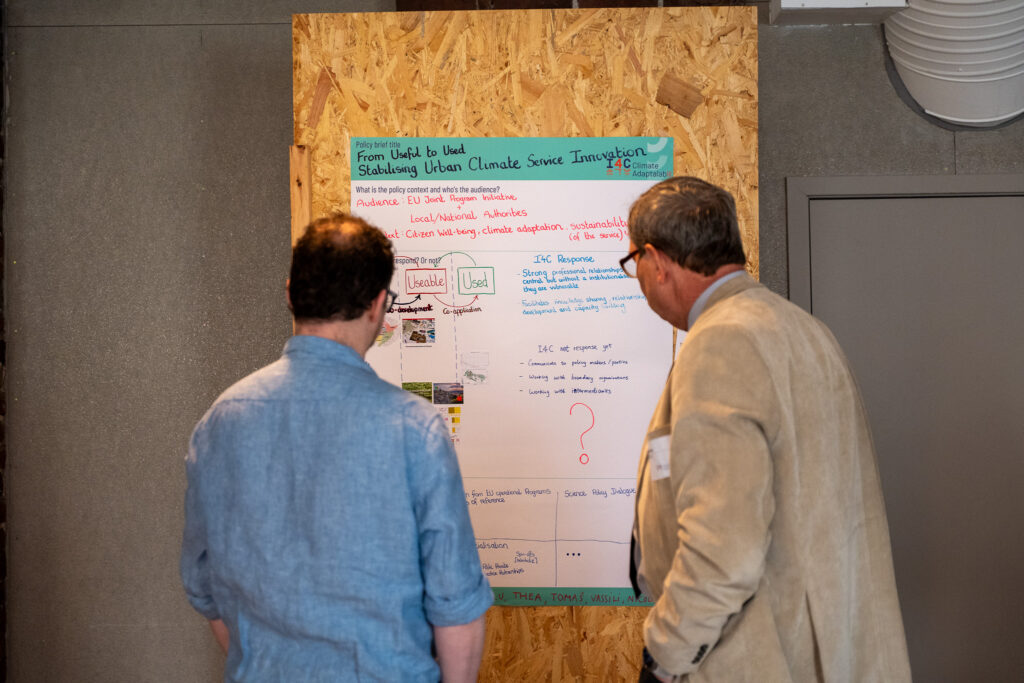
From research to policy: co-creating recommendations in Bergen
Since 2023, the I4C project has been hosting hackathon-style events in different partner cities (our Climate Adaptalabs), where scientists, city planners, climate service providers, policymakers and local experts wrestle with real adaptation challenges and walk away with a plan for solutions.
The 3rd Adaptalab, held in Bergen (Norway), marked a shift from the previous editions. This time, the goal wasn’t to co-develop concepts for climate services or toolkits for adaptation solutions in cities. This time, participants set out to distill everything the project had learnt so far into policy outcomes for cities and European decision-makers pushing climate adaptation plans through at municipal level.

That turned out to be far more than a writing exercise. Boiling down months of research into a handful of workable recommendations meant participants had to argue, compromise, and find common ground – then figure out how to say it in language a busy policymaker would actually read. Over the course of the workshop, ideas were pulled apart and rebuilt again and again, through conversation, pushback and genuine negotiation. Researchers challenged practitioners’ assumptions; practitioners pushed back on researchers’ abstractions; everyone built everyone else’s expertise.
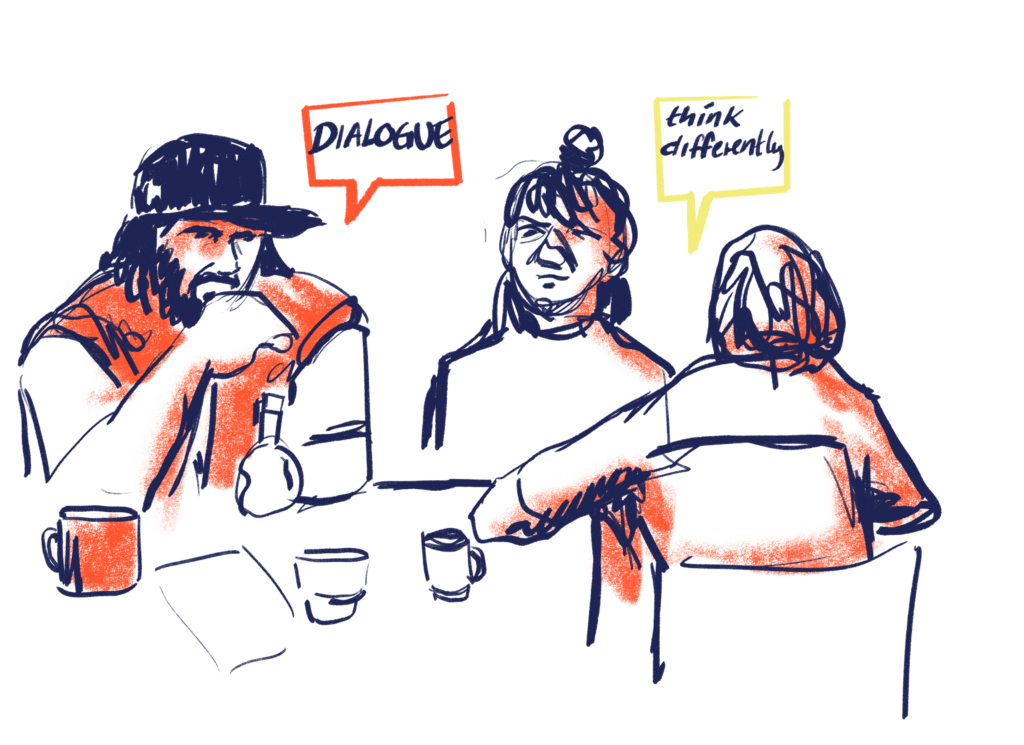
One unexpected addition made the whole process richer: illustrator Håvard Lægreid of Leketoys, who sat in the room not just documenting the discussion but actively shaping how it unfolded.
Rather than sketching a recap once everyone had gone home, Håvard worked in real time: watching arguments unfold, catching the moment a room shifted from confusion to consensus, and turning it all into illustrations as it happened. The results – his drawings are featured throughout the piece – captured something a slide deck or set of meeting notes never could: not just what was said, but how the thinking actually moved. In a very real sense, his drawings weren’t illustrations of the workshop – they were a record of collective thinking happening in real time.

Usually, art enters the picture at the very end of a research and innovation project – a nice illustration to accompany a report that’s already been written, the results already locked in. Bergen showed a different way of doing things. Here, art wasn’t a finishing touch; it was part of the thinking itself, helping participants make sense of complexity while the knowledge was still being built, and not after.
The case for arts-based co-creation: why visual methods matter in climate adaptation
Beyond the I4C project, researchers are increasingly documenting across sustainability work more broadly. A growing body of studies on arts-based approaches makes the case that creative methods don’t just decorate co-creation; they deepen it, giving participants a way into complex challenges that pure data and analysis can’t offer on their own. Visual approaches aren’t meant to replace evidence; they do something different – making abstract ideas tangible, surfacing connections between concepts that might otherwise stay buried, and giving people from wildly different disciplines a shared reference point to actually talk to each other. Art, in other words, isn’t just how you communicate the results of knowledge production, but it can be part of producing that knowledge in the first place (Wu et al.2019).
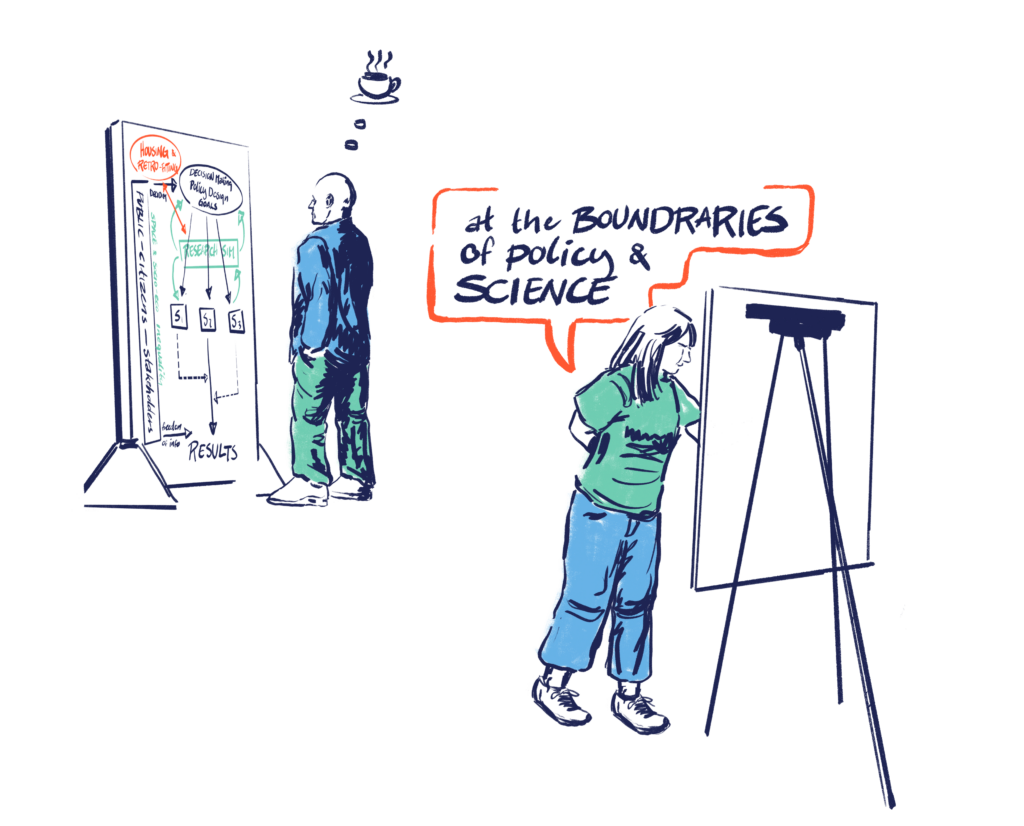
Recent work by Prall and Ounanian (2026) pushes this idea further, situating it within the wider story of climate adaptation. Their argument: tackling climate change takes more than technical know-how. It demands something harder to quantify – the collective capacity to imagine futures that don’t yet exist. The trouble, they point out, is that conventional participatory processes tend to stay boxed in by the very planning systems and habitual thinking they’re supposed to challenge, leaving little room to explore anything genuinely new. Arts-based methods, they suggest, offer a way out of this ‘imagination gap’: sparking creativity, reflection and dialogue, while also making co-creation processes more inclusive and more just.
Prall and Ounanian’s review points to why visual methods work so well in these settings: they make room for different ways of knowing, invite forms of expression that words alone can’t capture, and build trust between people who might otherwise struggle to find common ground. Bergen bore this out. The illustrations weren’t answers, and they weren’t just pretty summaries tacked on at the end, they were another way of seeing the room. Patterns across working groups became visible. Connections between themes that might have stayed buried in separate conversations suddenly showed up on paper, giving everyone a shared visual language alongside the written notes and policy debates. That mattered especially here, where participants were pulling on different threads toward one common goal: seeing it all mapped out visually helped people keep sight of how their pieces fit the whole.
Key takeaways for I4C
Returning to I4C, the Bergen Adaptalab offers 6 lessons for how the project – and cities more broadly – can think about co-creation going forward:
- Co-creation means building knowledge together, not handing it down. In the Adaptalab hackathon format, researchers, municipal staff, practitioners and policy experts worked as equals: no one was lecturing, everyone was contributing.
- How people collaborate matters as much as the evidence they bring. As climate adaptation becomes a bigger priority for European cities, the quality of the collaborative process is just as important as the quality of the data behind it.
- Live illustrations aren’t a magic fix. It doesn’t replace careful facilitation or genuinely inclusive participation, but it does have a real role to play alongside them.
- Creative methods belong inside co-creation, not on the sidelines. Following Prall and Ounanian, art supports a co-creation process that takes multiple perspectives seriously, stretches collective imagination, and treats fairness as non-negotiable.
- Illustration became part of the work, not just documentation of it. By helping participants see connections, track how ideas evolved, and reflect together, the drawings actively shaped the outcome rather than just recording it.
- Innovation isn’t only about better data or technology. Sometimes it’s about finding better ways for people to think together, and art can sit at the center of how knowledge gets made, shared, and turned into action.
What’s next?
The 3rd Adaptalab is one example of a wider trend across climate research: art being used not simply to illustrate what’s already known, but to help generate new knowledge in the first place. As the project moves forward, look out for future updates from the Adaptalab series as it continues testing new ways to bring research, practice and policy into the same room. And if this piece has sparked your curiosity about what arts-based methods can offer sustainability and climate work more broadly, here’s a list of additional resources that are a great place to start digging deeper:
- “How can we use the arts to unlock climate conversations with young people?” https://www.anewdirection.org.uk/blog/how-can-we-use-the-arts-to-unlock-climate-conversations-with-young-people
- “The arts and participation: a route to scaling climate action”: https://gulbenkian.pt/uk-branch/blog/the-arts-and-participation-a-route-to-scaling-climate-action/
- Artists for climate. https://artistsforclimate.org/