
Final I4C Adaptalab delivers policy-ready options
The third I4C Climate Adaptalab took place from 16–18 June 2026 at Litteraturhuset Bergen. This final edition marks a clear transition for the Adaptalab series – from exploration and tool development towards the synthesis of project results into concrete policy recommendations.
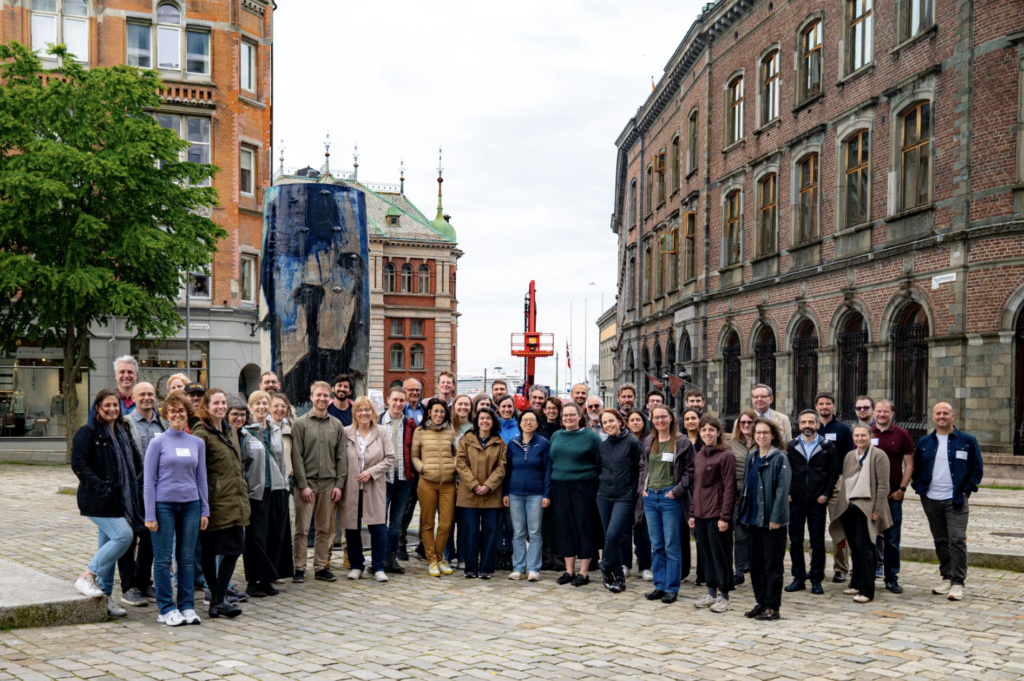
Following earlier editions in Paris (2023) and Barcelona (2025), Bergen brought together over 45 participants among I4C researchers, city practitioners, and other stakeholders to translate accumulated knowledge, data, and experience into targeted policy briefs designed to support climate adaptation decision-making in cities across Europe.
The outputs of the event will contribute to the long-term impact of the project and feed into the I4C policy event in Brussels in 2026.
Click here to read the final report!
From project results to probabilistic risk insights
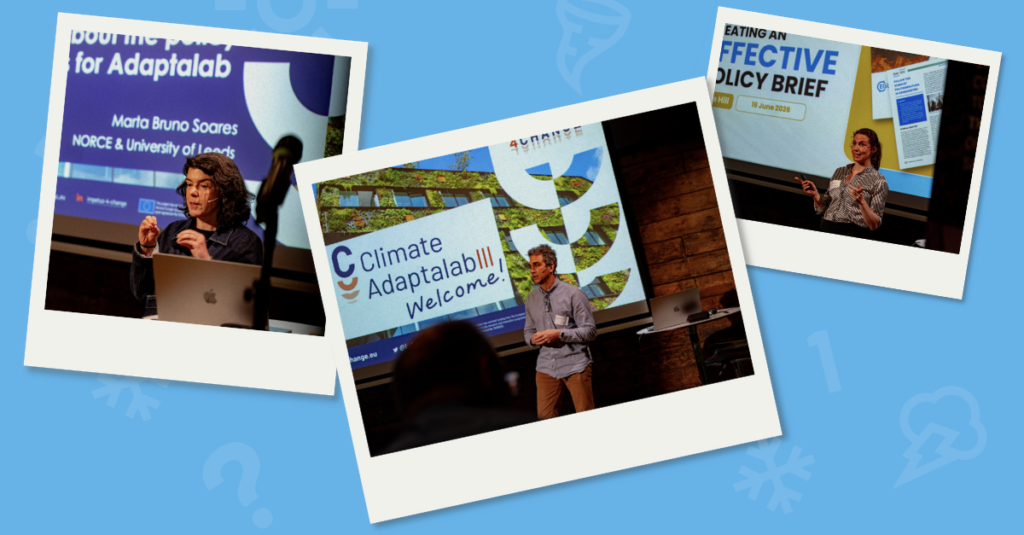
The Adaptalab opened with a series of presentations that set the scientific and policy context for the hackathon and reflected on the evolution of the I4C project and the Adaptalab series. Stefan Sobolowski, I4C project lead (NORCE), presented key project results, highlighting how I4C outputs now enable the capture of climate variability in ways that support probabilistic assessments of near-term climate risks. He also illustrated concrete applications already being developed across partner cities, including sub-seasonal heatwave outlooks in Barcelona, high-resolution modelling in Paris to identify heat-vulnerable areas and communities, climate vulnerability assessments in Bergen, blue-green infrastructure planning tools in Newcastle, and heat adaptation scenarios in Prague. Together, these examples demonstrated how project results are being operationalised across diverse urban contexts.
Chloe Hill, Science for policy manager, European Geosciences Union (EGU), outlined key characteristics of effective policy briefs and their role in bridging science and decision-making, helping frame the expected outputs of the Adaptalab. Marta Bruno Soares, Co-lead of the I4C team dedicated to Knowledge Networks, introduced the main policy themes guiding the group discussions, ensuring a shared focus across participants.
Finally, Mathew Stiller-Reeve, Adaptalab organiser and I4C project partner, situated the Adaptalabs within a broader trajectory of climate action-oriented hackathons spanning nearly a decade, emphasising their role as a sustained co-creation format linking science, policy, and practice.
From framing to collaborative work
Following the opening presentations, participants moved into an intensive phase of collaborative work, where the focus shifted from framing the scientific and policy context to actively shaping the content of the policy briefs. A networking exercise helped establish connections across disciplines, cities, and sectors, setting the tone for the group work that followed.
The working sessions were designed as a progressive process, with each activity building on the previous one. Participants worked in interdisciplinary groups to refine key messages, discuss priorities, and translate project knowledge into actionable policy insights. Through structured facilitation and iterative exchanges, ideas were continuously tested, challenged, and refined from different perspectives.
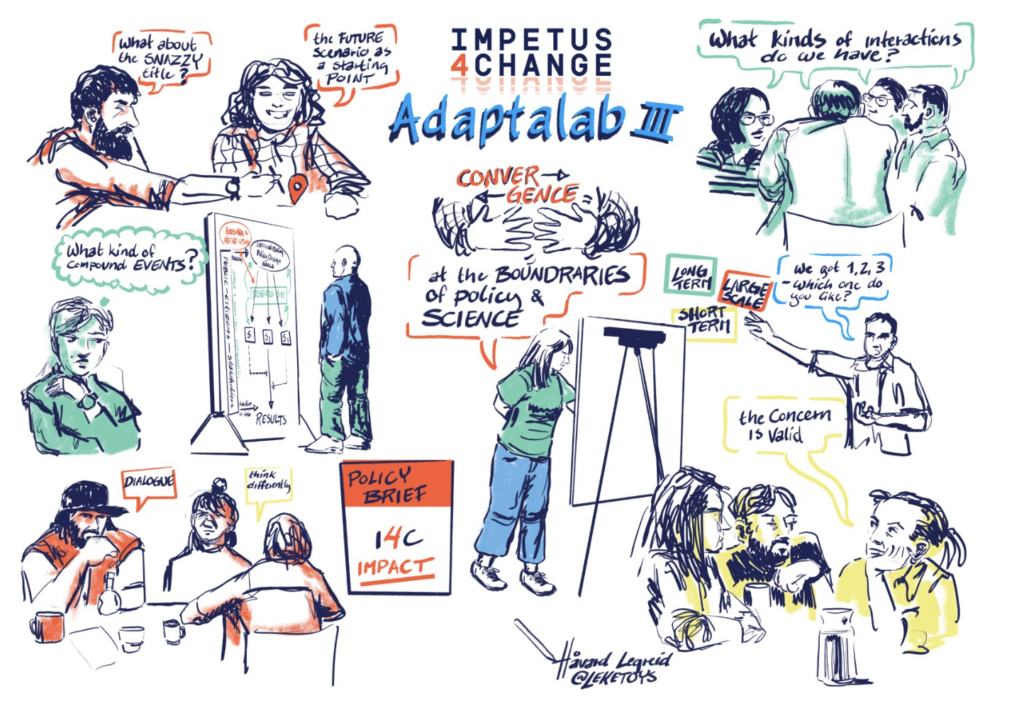
An additional layer to the Adaptalab was provided by a special guest, illustrator Håvard Lægreid of leketoys, who produced live visual notes throughout the event. Observing the discussions across groups, he captured in real time how participants collaborated, how ideas emerged and evolved, and how teams navigated moments of uncertainty and alignment. His illustrations added a complementary narrative layer to the co-creation process.
The collaborative work was structured around four thematic policy areas, with participants contributing across interdisciplinary working groups. The main insights, discussions, and emerging recommendations were synthesised into six posters, which captured the key messages developed during the Adaptalab.
Together, these thematic outputs provide the foundation for the policy briefs that will be further refined in the coming months and presented at upcoming I4C policy events.
What are the participants saying?
During and after the event, participants shared their enthusiasm and satisfaction about taking part in such a collaborative and immersive experience.
Nicolas Laurelle, regional planner for the Paris Region, one of the four metropolitan regions involved in the I4C project, has had the opportunity to participate in all three I4C Adaptalabs — in Paris (2023), Barcelona (2025) and Bergen (2026), and he offered to share some thoughts about this particular event.
“Adaptalabs are inspiring, surprising – with paradigm shifts and conceptual leaps around every corner – and sometimes simply reassuring. Adaptalabs make us stronger, both as a community and as individuals, professionally and personally.”
Rémy Bonnet, climate scientist from CNRS stressed the importance of sitting at the same table as policymakers, especially representatives from local municipalities:
“We have a lot to learn from each other. I’m really curious to see how they’ll use our results. We can support them, and we can also adapt our research based on the data they share with us and what proves most useful for climate adaptation and climate policy”.
Irene Navarro Solé, an environmentalist at the Barcelona Metropolitan Strategic Plan (PEMB), highlighted the value of working in small, stable groups as a way to foster meaningful conversations, regardless of one’s networking skills.
“We have been able to get to know each other better and have in-depth discussions on climate adaptation”.
I4C Roadshow brought climate knowledge into public space in Bergen
Alongside the climate hackathon, the I4C Make It Real Roadshow engaged the public in central Bergen at Torgallmenningen.
The Roadshow extended the Adaptalab beyond the workshop setting into the public space, creating opportunities for direct dialogue with citizens on climate knowledge and urban climate action. Visitors were invited to explore how climate information is used in practice and to reflect on its relevance for everyday decision-making.
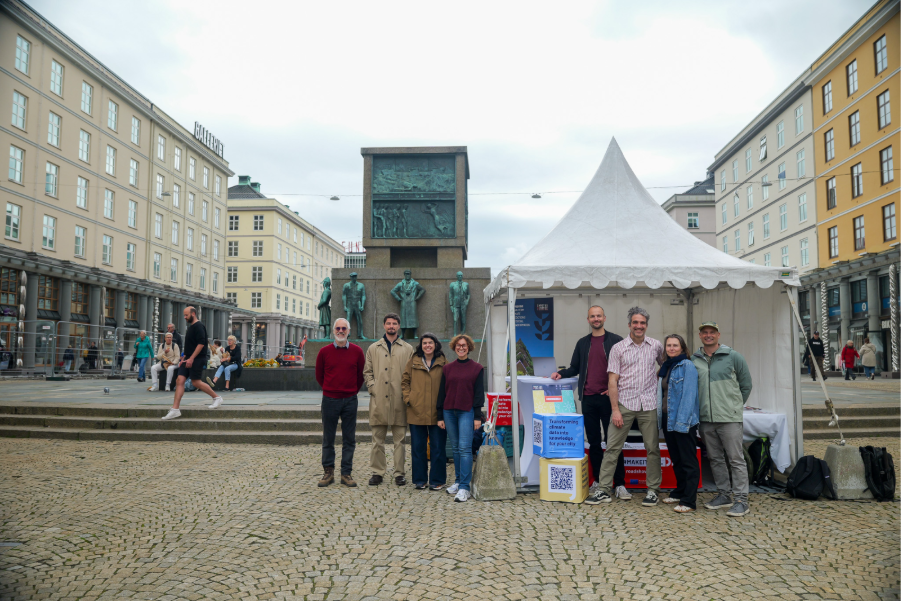
A central element of the activation was the ‘Make It Real’ quiz, designed to make key climate concepts more accessible to non-expert audiences. The quiz combined lived experience with foundational ideas such as climate variability, uncertainty, and the distinction between climate projections and predictions.
By creating space for informal exchange, the Roadshow complemented the Adaptalab by broadening the conversation beyond the expert community and strengthening the link between climate science and public understanding.
What’s next?
The policy briefs developed during the Adaptalab will be further refined in the coming months and will contribute to the I4C policy event in Brussels in 2026. The outputs are intended to support more effective translation of climate knowledge into actionable strategies for urban climate adaptation across Europe.
And there is more to come!
Keep an eye out on I4C socials for updates in the coming months – including video interviews with representatives from the demonstrator cities we spoke to in Bergen – and announcements of upcoming Roadshow dates!