Testing the next generation of climate datasets: I4C at “Le Climat en Données”
Climate data isn’t just for scientists. The Impetus4Change (I4C) project supports climate resilience by bringing science, policy, and communities together, helping turn climate knowledge into practical tools for decision-making.
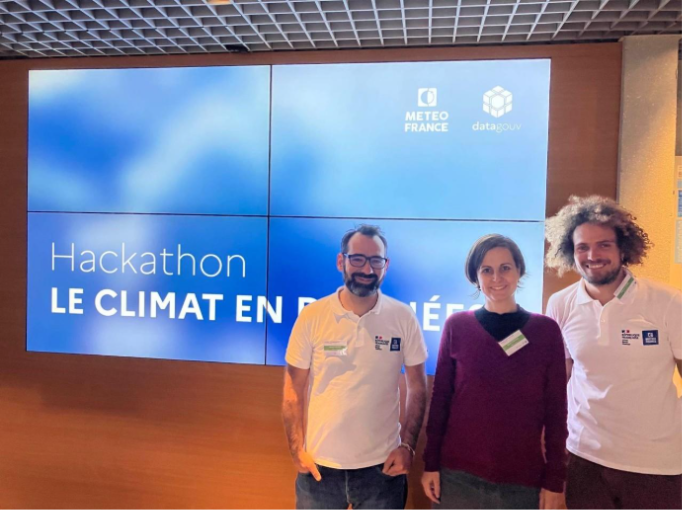
At the “Le Climat en Données” hackathon, held from 2-4 December 2025 at Météo-France headquarters in Toulouse (France), participants had the opportunity to present and test a new generation of national climate datasets being developed in France to support the next National Climate Change Adaptation Plan.
At the end of last year, we sat down with Sam Somot, Météo-France, who is part of the team in I4C developing new datasets and modelling tools.
Below is a recap of his experiences at the hackathon and why it is important to bring researchers and practitioners together to play with data.
“Through this contribution, I4C positioned itself as a key provider of high-value climate data and modelling approaches, both for the future national climate services portal and for the design of adaptation policies.”
Sam Somot – Météo-France
Why the hackathon was important for I4C
By providing early access to forthcoming national climate datasets, the event created a real user-driven test environment. For I4C, the hackathon marked a shift from simply presenting datasets to seeing them actively used. High-resolution datasets and tools developed by I4C make it possible to look closely at city-level extreme climate event simulations. Participants used project and other datasets to perform these refined simulations, from mapping heatwave exposure for elderly populations to assessing how extreme heat could affect rail transport.
Reaching new users beyond research
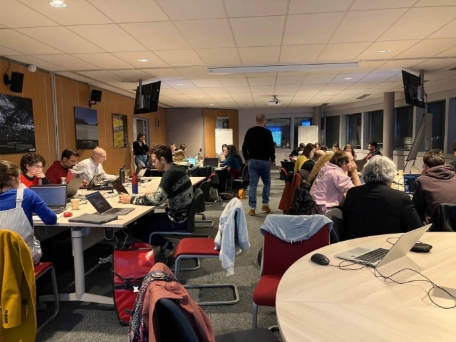
What made the event particularly valuable for I4C was the diversity of participants. Of the 150 hackathon participants, half attended in person and half joined online; only 10% were from the research community.
Click here to dive into the event highlights!
The majority represented operational and professional users, including SMEs working on climate services, data journalists, public bodies, students, urban and water managers, and representatives from major companies in sectors such as insurance, energy, and transport (i.e., SNCF).
“I discovered a landscape of people using local-scale climate change data. I wasn’t aware of how many people are interested in using them to develop new climate services!”
Sam Somot – Météo-France
This shift from research-only exchanges to hands-on experimentation helped I4C reach new stakeholder groups and demonstrate the practical value of its data beyond the research community.
The event also underlined the role of SMEs as intermediaries between climate data providers and decision-makers, translating technical information into operational tools and services.
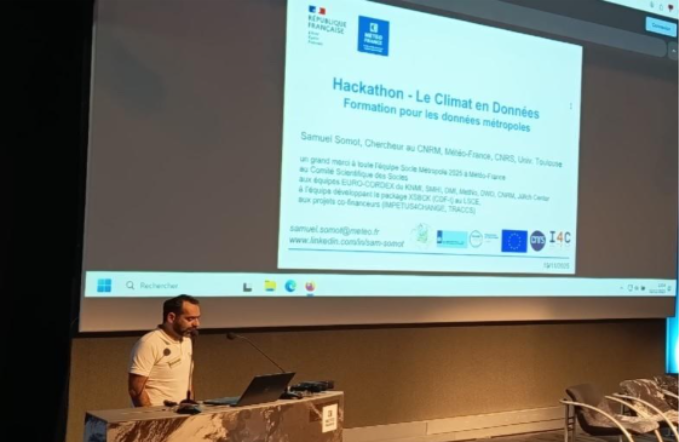
This transfer of knowledge across a broad, diverse audience would not have been possible without training sessions by mentors, enabling even non-specialists to work meaningfully with advanced climate datasets.
From data to concrete applications
One of the most important outcomes of the hackathon was seeing climate data rapidly turned into real-world applications. Participants worked with three main families of climate datasets (all open access):
- EURO-CORDEX (2nd generation climate projections)
International climate projections at around 12 km resolution, widely used across Europe and well suited to daily-scale analysis.
- Very high-resolution convection-permitting climate simulations
Kilometre-scale models with hourly time steps, designed to capture short-duration extremes such as thunderstorms and Mediterranean heavy precipitation events, and to support detailed city-level analysis.
- AI-based downscaling datasets
Neural-network approaches that can produce high-resolution climate information efficiently, expanding the range of tools available for climate services and adaptation planning.
All applications developed during the hackathon are available for open access and can be explored here.
The second and third datasets listed above were developed within I4C’s Work Package 3. Interest focused most strongly on the high-resolution convection-permitting simulations.
“The very high-resolution datasets developed within I4C were among the most in-demand resources during the Hackathon. Many teams used them to analyse extreme precipitation at sub-daily time scales, such as thunderstorms or Mediterranean heavy precipitation events.” Sam Somot – Météo-France
Their ability to zoom in on hazards at the city scale allowed teams to develop use cases directly relevant for urban adaptation planning, including:
- Urban heatwave impacts on vulnerable populations, for example, mapping heat exposure for residents aged 65+ and showing differences within cities. This work is illustrated through an interactive online application developed during the event. One team was recognised for its work (see the winning team announcement here).
- Link “interactive online application” to the Streamlit app.
- Link “winning team announcement here” to the LinkedIn post.
- Extreme precipitation at the city scale, including short-duration events such as thunderstorms and Mediterranean heavy precipitation.
- Transport infrastructure sensitivity to heat, for example, assessing risks for trains stopped at stations by combining climate hazards with material vulnerability thresholds.
Looking ahead: A good start
A surprising takeaway was participant enthusiasm around the data. Moreover, the simulations clearly showed why fine-scale climate information matters: it helps cities understand not only whether risks are increasing, but where, when, and for whom impacts will be most severe. This supports more targeted and effective adaptation strategies.
Looking ahead, high-resolution climate information, including convection-permitting simulations and AI-based approaches, will become increasingly central to locally tailored adaptation strategies, especially in cities where climate risks vary sharply between neighbourhoods and infrastructures.
Beyond the applications presented during the event, the hackathon underscored the growing role of hands-on formats in the climate adaptation landscape. More than a technical exercise, hackathons are powerful communication and knowledge-transfer tools: they create a rapid bridge between research and practice by allowing users to work directly with datasets, test ideas, and see what information can deliver in real-life contexts.
I4C will continue supporting it through engagement and co-creation activities, including the upcoming I4C Climate Adaptalab, strengthening the project’s policy and stakeholder legacy.
“Participation in the Hackathon provided I4C with a concrete opportunity to showcase both its data products and its expertise in a real-world, user-driven context. Several mentors involved in the event were also directly engaged in I4C, which enabled the project’s scientific and technical know-how to be transferred to participants through hands-on support and direct interaction.”
Sam Somot – Météo-France