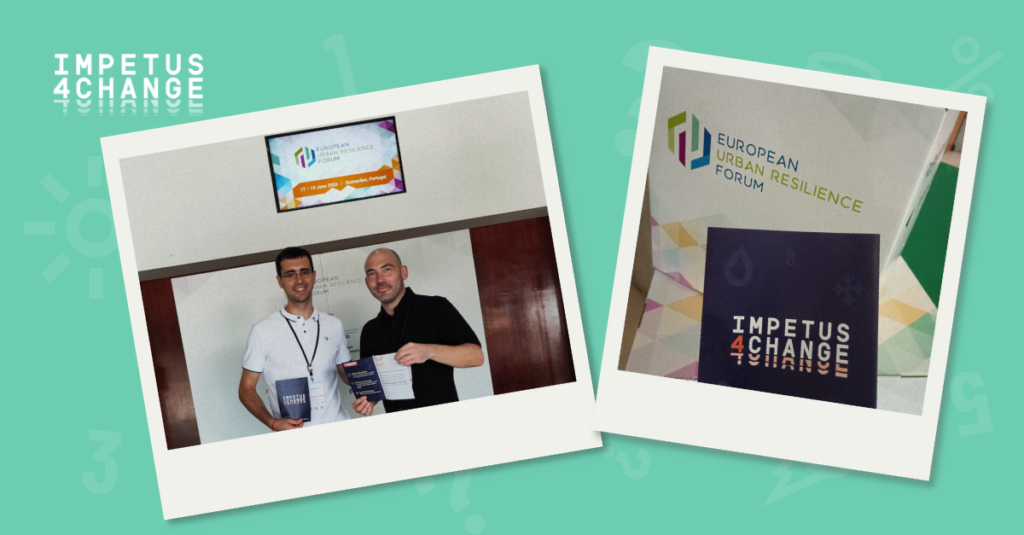
People at the heart of climate resilience: insights from EURESFO 2026
The 13th European Urban Resilience Forum (EURESFO), held this year in Guimarães, Portugal, brought together city representatives, researchers, policymakers and practitioners to explore how European cities can become more resilient in the face of climate change.
Organised by ICLEI Europe and the European Environment Agency (EEA), the forum focused on moving beyond climate adaptation planning towards integrated, practical action.
For the I4C team, the event confirmed that building resilience requires collaboration, good governance, accessible information and, above all, people-centred approaches that ensure climate knowledge can be translated into meaningful action to face challenges.
Let’s go more in depth!
Designing climate services that work for cities
Our team attended the session “Opening the resilience toolbox: solutions for safer urban spaces“, which explored how European cities are using climate risk assessment tools, governance frameworks and practical methodologies to strengthen planning, investment and emergency response. While the technologies presented differed from one city to another, speakers agreed on a common principle: tools only become valuable when they help decision-makers understand not only where climate risks exist, but also who is most affected.
This message strongly resonated with the objectives of I4C. Throughout the project, climate services have been co-developed with demonstrator cities and local stakeholders to ensure they respond to real challenges and can be integrated into everyday decision-making processes. I4C places collaboration at the centre of its approach, increasing the likelihood that its results will continue to deliver value beyond the project’s lifetime.
For Imanol Ugalde, researcher at ICLEI Europe’s Resilience and Climate Adaptation team, the session reinforced the importance of keeping people at the centre of innovation.
“A human-centred approach is needed to ensure that tools and data are meaningful in practice. They should be designed so that they can be used and understood by the people who need them.”
Creating demand for climate information
The other session attended by the I4C team, “Empowering cities with digital tools: roadmaps for accelerating climate resilience and risk-informed planning“, focused on how cities are combining climate, environmental and socio-economic data to support more informed decisions. Discussions also explored the challenges of transferring digital solutions between cities, recognising that differences in governance, local data and technical capacity mean that successful approaches often need to be adapted rather than simply replicated.
One of the most thought-provoking discussions centred on the relationship between climate services and decision-makers. Rather than assuming local authorities already know what information they need, speakers highlighted the importance of working together to build the capacity to ask the right questions and identify the most relevant climate information.
This reflects one of the key lessons emerging from I4C. The project’s engagement with its demonstrator cities has shown that stakeholder involvement is an essential step in ensuring that these services are relevant, trusted and ultimately used to support decision-making.
These experiences will also inform the development of the I4C handbook, helping translate project results into recommendations that can be applied in other European contexts.
As Sam Pickard, researcher at the Barcelona Supercomputing Center (BSC), agreed with the point made by Kristen Guida (Greater London Authority), who observed,
“Decision-makers are not always ready to articulate their data and information needs. Time and collaboration are needed to create an intelligent demand for data.”
His reflection highlights why co-creation remains a cornerstone of effective climate services.
Looking ahead
Beyond the individual sessions, EURESFO demonstrated that climate resilience is increasingly being shaped through collaboration between researchers, public authorities, communities and policymakers. While challenges linked to governance, financing and implementation remain, the forum showcased numerous examples of cities already putting innovative approaches into practice and generating lessons that can be shared across Europe.
For I4C, the event reaffirmed that effective climate services go beyond producing accurate forecasts or sophisticated digital tools. Their real value lies in helping people make informed decisions and enabling cities to translate scientific knowledge into practical action.
The insights gained in Guimarães will feed into the project’s ongoing work, supporting the development of guidance and recommendations that can help strengthen climate resilience well beyond the project’s demonstrator cities.
Stay tuned to discover more updates!